HomeThe Book

One connected journey through modern mysticism

The Book

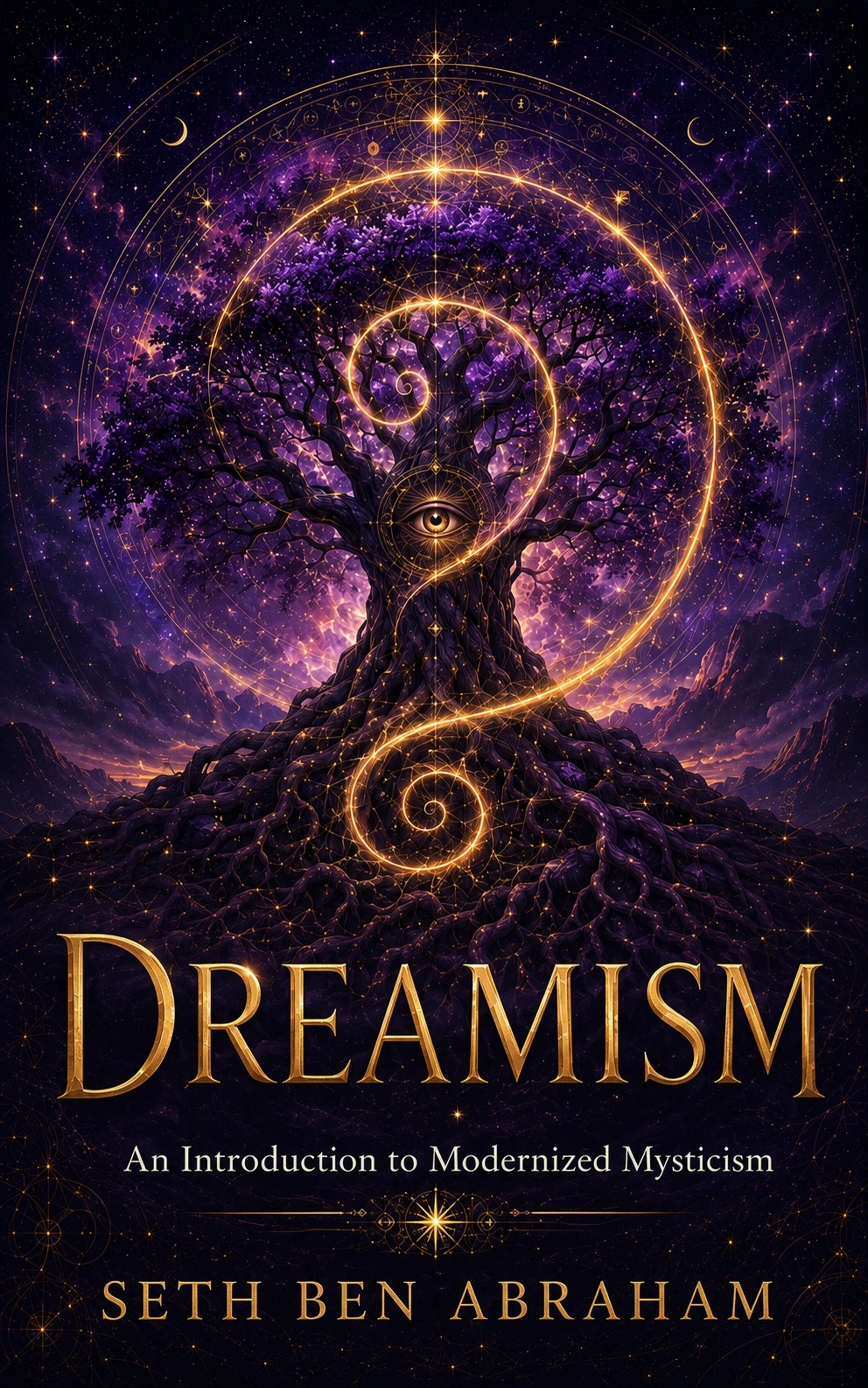
Dreamism: An Introduction to Modernized Mysticism presents the philosophy as a complete architecture. The volume begins with the nature of G-d and reality, follows consciousness into signs, intention, ritual, and daily practice, then turns toward civilization, ethics, the soul, and humanity’s possible future.

The website introduces individual ideas. The book follows the connections between them until metaphysics, practice, character, society, and repair become one continuous argument.

A three-dimensional copy of Dreamism displayed in a moonlit mystical observatory

What the volume is

A framework—not a cabinet of disconnected mysteries.

Dreamism brings together ideas that are often kept apart: Divine consciousness and scientific inquiry, Jewish mysticism and comparative religion, free will and causality, private experience and public ethics, sacred ritual and ordinary labor, the soul’s journey and the future of technology.

The purpose is not to collect strange claims. It is to show how a vision of reality changes the way a person interprets consciousness, forms intention, organizes time, treats other beings, uses power, and participates in creation.

The book asks the reader to move from wonder into understanding, from understanding into practice, and from practice into responsibility.

Four movements through the Dream

The argument widens as the reader travels.

The ten chapters are arranged so that each movement supplies the questions and vocabulary needed for the next.

IReality and perception

The Dreamer, the Dream, and the signs within it

Chapters 1–3 develop G-d as the Divine Dreamer, Order and Chaos as living currents, and synchronicity as a field requiring attention without forced interpretation.

IIIntention and formation

Magic, ritual, and the instruments of practice

Chapters 4–5 show how consciousness becomes speech, symbol, art, habit, prayer, meditation, journaling, sacred space, and deliberate action.

IIICivilization and conduct

Babylon, ecology, and an ethical compass

Chapters 6–8 examine manufactured reality, concentrated power, environmental responsibility, consumption, community, justice, and the standards by which spirituality must be judged.

IVSoul and horizon

The journey beyond one life and one civilization

Chapters 9–10 explore layers of soul, embodiment, reincarnation, resurrection, technology, artificial intelligence, collective consciousness, and humanity beyond survival.

Chapter map

Ten chapters build the complete philosophy.

01

G-d and the Divine Dream

G-d beyond the human caricature, tsimtsum, the sefirot, sacred geometry, science at the edge of mystery, and the role of conscious beings inside creation.

02

Order & Chaos

The two currents, living balance, love, uncertainty, nature, words, forgotten lives, hidden sparks, children, and repair inside an unfinished world.

03

Synchronicities & Signs

Coincidence, miracles, anomalies, participation, the rendered world, mystical traditions, discernment, and the difference between noticing and forcing meaning.

04

Magic & Ritual

Intention, belief, prayer, collective attention, artists as magicians, ritual order, sacred meals, Shabbat, sigils, and ordinary acts charged with meaning.

05

Dreamist Tools

Journaling, Mussar, meditation, grounding, hitbodedut, kavanah, dreams, lucid states, language, sacred space, and the disciplines that train the instrument.

06

Babylon & Zion

The cities within the soul, manufactured reality, exhaustion, spectacle, wealth, scarcity, state power, poisoned attention, disengagement, and constructive return.

07

Environmental Stewardship

The living body of the Dream, food systems, climate, biodiversity, consumption, ecological grief, practical repair, and responsibility beyond purity tests.

08

Ethics in Dreamism

Non-harming, compassion, truth, fairness, respect for life, stewardship, cooperation, mindful consumption, growth, accountability, and the conduct that gives belief credibility.

09

The Soul’s Journey

The soul as an expression of G-d, its layers, embodiment, forgetting, reincarnation, resurrection, soul families, purpose, and the World to Come.

10

The Future of Humanity

A civilization beyond survival, mature power, artificial intelligence, collective mind, digital worlds, interstellar life, technology as intention, and humanity’s developing soul.

Why the long form matters

Some ideas only become clear through sequence.

A webpage can explain what Dreamism means by magic. The book can first establish its model of consciousness, show how intention enters shared reality, distinguish personal experience from evidence, connect art to collective attention, place ritual inside ethics, and then follow the consequences into society.

That sequence matters. It prevents mystical language from floating free of context and prevents practical instruction from becoming a list of techniques without a philosophy of why they matter.

Context accumulates.

Later ideas inherit definitions, distinctions, and ethical limits established earlier.

Apparent opposites can meet.

Reason and wonder, individuality and interdependence, freedom and causality, rest and responsibility are examined together rather than reduced to slogans.

Practice has a destination.

The inward path keeps widening until it reaches relationships, institutions, ecology, technology, and future life.

An open illuminated book resting on a mystical altar beneath golden sacred geometry

What makes the book distinct

Mysticism without surrendering the mind—or the world.

Wonder and scrutiny

Critical thought remains inside the spiritual path.

Science, evidence, skepticism, metaphor, speculation, intuition, and mystical interpretation are allowed to contribute without being confused with one another.

Many sources, one framework

Traditions are placed in conversation.

Jewish mysticism provides profound language and structure while other religious, philosophical, psychological, and scientific perspectives expand the inquiry.

No conversion demand

Dreamism can coexist with another religious identity.

The book offers a framework for interpreting reality and living intentionally rather than requiring readers to abandon inherited faith, culture, or community.

No personality cult

The ideas must stand beyond the author.

Readers are invited to examine, test, adapt, question, and develop the framework rather than surrender conscience to a spiritual authority.

Ethics as verification

Insight is measured by its fruit.

Claims of awakening are tested through humility, honesty, compassion, consent, responsibility, creativity, and the repair of actual conditions.

The future remains open

Humanity is treated as unfinished.

The final movement asks what civilization, consciousness, technology, and the soul may become when survival no longer consumes the whole horizon.

A celestial observatory beneath lunar phases, planets, and a luminous purple sky

For the reader between categories

Written for people who cannot choose between reason and wonder.

The book is intended for readers who feel the sacred dimension of existence but remain wary of dogma, manipulation, anti-intellectualism, spiritual consumerism, and easy certainty.

It also speaks to people who value science and critical inquiry yet find that a purely mechanical account of life leaves consciousness, meaning, beauty, grief, creativity, and moral responsibility insufficiently described.

Spiritual but discerningJewishly curiousPhilosophically mindedScientifically literateCreatively drivenSocially concernedRecovering from dogmaSeeking an integrated path

Ways to read

The volume supports more than one kind of journey.

01

Read the argument in order.

Move from the Divine Dream through practice and civilization to the soul and future humanity. This preserves the full conceptual architecture.

02

Follow one thread across chapters.

Trace consciousness, magic, ethics, technology, nature, prayer, social power, or the soul wherever that thread reappears.

03

Read with a working notebook.

Record questions, disagreements, synchronicities, practices attempted, changes in interpretation, and the consequences that become visible over time.

04

Discuss it with others.

Use chapter questions to compare assumptions, test interpretations, and keep one reader’s certainty from becoming the entire conversation.

05

Return after experience.

Sections on grief, ritual, community, signs, technology, and the soul may disclose different meanings after life has changed the reader.

The destination

The final question is what the reader helps create.

The book does not conclude by offering escape from the material world. It returns the reader to it with a larger account of consequence. Conscious beings influence the Divine Dream through attention, speech, art, labor, relationships, institutions, technology, and the conditions passed forward.

The World to Come is therefore not only a realm beyond death. It is also the future reality being prepared by what humanity chooses to normalize, protect, invent, remember, and repair.

A spiritual philosophy becomes complete only when its vision of the sacred changes its treatment of life.
A vast purple cosmic library with open books and luminous constellations

About the author

Seth Ben Abraham

The book grew from years of study across mysticism, philosophy, religion, consciousness, science, symbolism, dreams, ethics, and the social forces that shape lived reality. Its purpose is not to establish a spiritual office around the author, but to offer a framework readers can examine and develop through their own lives.

Questions about the work, interpretation, or emerging Dreamist community can be sent to dreamism@gmx.com.

Enter the complete journey

Dreamism: An Introduction to Modernized Mysticism

The Amazon listing contains the current purchasing and format options for the book.

Scroll to Top